Every logistics and manufacturing unit in India faces the same decision at some point. Which truck weighbridge should you buy? Who should you buy it from? And how do you avoid a maintenance nightmare six months later? The answer matters more than most buyers realise. Prices vary wildly between suppliers. Specifications look similar on paper, but perform very differently on site. Moreover, after-sales support is rarely discussed until it is already too late.
This guide is for plant managers, procurement heads, and operations teams. It gives you a clear, practical breakdown of the truck weighbridge market in India — including which manufacturers deserve serious consideration and which mistakes to avoid before signing a purchase order.
What Is a Truck Weighbridge and Why Does It Matter?
A truck weighbridge is a large platform scale. It measures the gross weight of loaded trucks, tippers, tankers, and other heavy commercial vehicles. In industrial operations, it serves as the primary point of weight-based billing and material reconciliation. Additionally, it keeps businesses compliant with India’s Legal Metrology Act.
A standard installation includes a structural steel or RCC platform. Load cells sit beneath it. A junction box consolidates their signals. A digital indicator displays the weight. Finally, weighing software handles ticket generation and data records. Every component matters equally. Good electronics on a poorly fabricated platform produce inconsistent readings. Similarly, a solid structure with low-grade load cells drifts out of calibration within months.
Types of Truck Weighbridges Available in India
Before approaching any manufacturer, you need to know which type suits your site. Here are the five main options available in the Indian market.
Pitless (Surface-Mounted) Truck Weighbridge
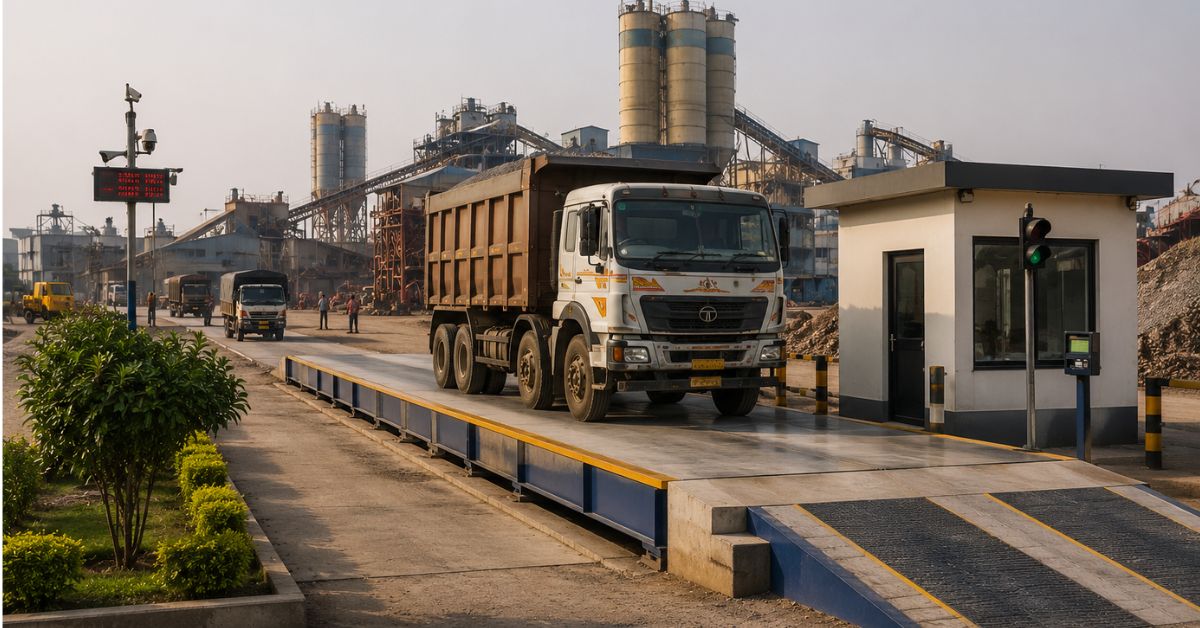
This is the most common type across India. The platform sits above ground on a concrete foundation. Approach ramps on both ends allow trucks to drive up and off. Civil work is simpler and less expensive. Furthermore, maintenance teams access it easily, and you can relocate it if your plant layout changes.
Cement depots, coal yards, steel plants, and aggregate quarries all favour the pitless design. For most industrial setups processing 100 to 300 truck movements per day, this is the default choice.
Pit-Type Truck Weighbridge
In a pit-type installation, the platform sits flush with the ground inside a concrete pit. As a result, trucks drive on at ground level without needing ramps. This design works well at high-throughput gates or wherever space constraints make ramps impractical.
The tradeoff is higher civil costs. Deeper excavation and mandatory drainage add to the project budget. However, for sites handling 400 or more truck movements daily, the smoother traffic flow justifies the additional investment.
RCC (Reinforced Cement Concrete) Truck Weighbridge
Many buyers overlook the RCC weighbridge, yet it appears widely across India in permanent, long-term installations. Instead of a fabricated steel deck, builders construct the platform using reinforced concrete — the same structural principle as a bridge slab.
RCC platforms resist corrosion effectively. Therefore, they suit coastal sites, high-humidity environments, and locations where chemical spillage from truck loads might damage a steel deck. They also need very little surface maintenance over their lifetime. In harsh conditions, RCC platforms outlast steel platforms by several years.
On the other hand, civil construction takes longer. Structural repairs are harder to carry out compared to steel. Additionally, you cannot relocate an RCC platform once you build it. Nevertheless, for a permanent industrial site — a cement plant, a port terminal, or a steel facility — an RCC truck weighbridge is a sound long-term investment.
Portable / Modular Truck Weighbridge
Manufacturers assemble this system from multiple platform sections that bolt together on-site. Operations teams use it when the weighing location changes over time. Mining operations that shift working faces or large infrastructure projects both benefit from this flexibility. It does not replace a permanent installation in terms of accuracy or durability. However, it provides operational flexibility that fixed systems simply cannot match.
In-Motion Truck Weighbridge
These advanced systems capture truck weight while the vehicle moves slowly through the weigh zone — typically at 5 to 10 km/h. Port terminals, automated logistics parks, and highway enforcement authorities use them most often. They significantly improve gate throughput. However, they cost more and require experienced engineers for installation and calibration.
Key Technical Specifications Every Buyer Must Understand
Platform Capacity
Standard capacities in India range from 30T to 120T. For most 10-wheel tippers and 12-wheel trucks, a 60-tonne system is the industry standard. For multi-axle vehicles or mining dumpers, move up to 80T or 100T. Never buy at your exact maximum load. Operating near the rated limit repeatedly accelerates load cell fatigue and shortens platform life.
Platform Dimensions
Standard platform lengths are 18 metres and 24 metres. An 18-metre platform handles most 10-wheel and 12-wheel trucks comfortably. For longer multi-axle trailers or tankers, choose a 24-metre platform. This ensures the full vehicle sits on the deck simultaneously, which is critical for accurate gross weight readings. Platform width ranges from 3 to 4.5 metres. Wider platforms reduce off-centre loading errors.
Load Cell Quality
Load cells convert mechanical force into an electrical signal. They directly determine your weighbridge’s long-term accuracy more than any other component. Always ask the manufacturer which load cell brand they use. Check whether the cells carry OIML R60 certification. Also, confirm their IP (Ingress Protection) rating. For outdoor installations, choose IP67 or IP68-rated load cells. These handle rain, dust, and occasional waterlogging without degrading.
Legal Metrology Compliance
Indian law requires verification and stamping of any weighbridge used for commercial transactions. The state Weights and Measures department carries out this process under the Legal Metrology Act, 2009. The system must meet OIML R76 accuracy Class III or better. Therefore, always confirm that the manufacturer designs their systems to this standard. A credible supplier also helps you through the verification process.
What Is a Truck Weighbridge and Why Every Logistics Company in India Needs One?
Top Truck Weighbridge Manufacturers in India
The following manufacturers have established credible track records in the Indian market. This is not an exhaustive directory. Instead, it focuses on suppliers worth evaluating seriously.
Essae-Teraoka Ltd.
Essae-Teraoka operates as a joint venture with Japan’s Teraoka Seiko. The company has worked in India since the early 1990s. It ranks among the most recognisable names in electronic weighbridge manufacturing. Their systems serve cement, steel, and large logistics operations. Moreover, their software is ERP-ready, and their service network covers most major industrial regions.
Accurate Weighing Systems
Accurate Weighing Systems operates from Pune. The company handles non-standard requirements well — unusual platform dimensions, high-capacity configurations, and custom builds for ports or heavy industry. It has a strong presence in western and southern India. Buyers choose it often when standard dimensions simply do not fit the application.
Swisser Instruments Ltd.
Swisser operates from Mumbai and maintains a pan-India dealer network. The company has installed truck weighbridge systems in cement plants, fertiliser facilities, and commodity warehouses. Their digital indicators have improved considerably in recent years. As a result, they now compete well in the mid-to-large enterprise segment.
Mastech Weighing Solutions
Mastech is a strong choice for small and medium enterprises. It offers reliable industrial weighbridge solutions without premium pricing. The company’s systems appear frequently in aggregate quarrying, sand mining, and regional logistics operations. Furthermore, their service response in tier-2 cities generally outperforms larger national brands.
B-Tek Scales (India)
B-Tek brings a mature software platform to a market where software is often an afterthought. Their integrated system handles ANPR-based vehicle identification, tare weight management, and dispatch integration. Few domestic manufacturers currently match this capability. Consequently, B-Tek is a strong choice for high-throughput operations that need automation.
Avery Weigh-Tronix (India)
Avery Weigh-Tronix carries global recognition in heavy industrial weighing. Their India operations supply truck weighbridges to ports, steel plants, and large logistics parks. Their systems sit at the premium end of the price range. Nevertheless, they carry strong technical documentation and international product standards. MNC facilities and export-oriented units with strict audit requirements often prefer this brand.
Regional Fabricators
Gujarat, Punjab, and Andhra Pradesh host a substantial base of regional manufacturers. They fabricate platforms using locally sourced steel and integrate load cells from established brands. These suppliers offer cost-effective solutions for simple, lower-frequency applications. However, always evaluate their build quality and after-sales capability carefully before committing.
What Good Truck Weighbridge Software Must Deliver
The platform and load cells handle the weighing. However, software determines how efficiently the site operates around them.
A good truck weighbridge management system handles several key functions. First, it manages vehicle tare weights so drivers do not weigh empty on every visit. Second, it generates GST-compliant weight tickets automatically. Third, it maintains a tamper-evident audit trail with timestamps and operator IDs. Finally, it integrates directly with your ERP or accounting system — whether SAP, Tally, or a custom dispatch platform.
Several leading truck weighbridge manufacturers in India now offer optional ANPR cameras at the gate. These cameras automatically read incoming vehicle number plates and retrieve registered tare weights without operator input. For sites processing 200 or more trucks daily, this technology pays for itself quickly through faster gate cycles and fewer data entry errors.
Common Mistakes That Cost Buyers Dearly
Buying on price alone. The gap between a ₹10 lakh and a ₹17 lakh system can disappear within a year. A better system reduces downtime and processes trucks faster. Therefore, measure the total cost of ownership over seven to ten years — not just the purchase price.
Ignoring the total project cost. Civil foundation work, drainage, electrical supply, ramp construction, and Legal Metrology stamping all add to the final bill. These extras can total ₹5–10 lakh beyond the equipment price. Always ask for a complete turnkey estimate before comparing suppliers.
Underspecifying for future growth. Buy for where your operations will be in five years. A weighbridge that fits your current fleet perfectly may become a bottleneck when you add larger vehicles or increase daily throughput.
Skipping service network verification. Before finalising any truck weighbridge supplier in India, call their regional service number during working hours. Ask how many engineers work near your plant. A single regional distributor is a very different commitment from a dedicated on-ground service team.