Did you know that under India’s Legal Metrology Act, 2009, every business that buys or sells goods by weight is legally required to use a verified, accurate weighing instrument? And yet, thousands of Indian manufacturers, traders, and factory operators are still using outdated mechanical scales that drift by 2–5% — costing them lakhs every year in measurement errors, compliance penalties, and lost customer trust.
If you are searching for the right electronic weighing scale — whether for your factory floor, warehouse, retail counter, or laboratory — you are in the right place. In this guide, we break down exactly what an electronic weighing scale is, the main types available in India, the key benefits for your business, and the 7 critical factors to check before placing an order.
What Is an Electronic Weighing Scale?
An electronic weighing scale is a precision instrument that measures the weight or mass of an object using electronic sensors called load cells. When an item is placed on the platform, the load cell converts the applied force (weight) into a small electrical signal. A built-in processor amplifies and converts that signal into a number, which is displayed on a digital LCD or LED screen.
Unlike old-fashioned mechanical spring balances — which wear out, lose accuracy, and need frequent readjustment — electronic scales deliver stable, repeatable readings with minimal human error. Most models offer a readability (smallest measurable increment) of 1 gram to 10 grams depending on capacity, and many connect to computers, printers, or ERP software for automated data capture.
One thing many buyers in India miss: electronic weighing machines used for commercial transactions must comply with BIS standard IS 9873 and carry a valid verification stamp from the Weights & Measures department. This makes choosing a certified electronic weighing machine India a legal requirement, not just a quality decision.
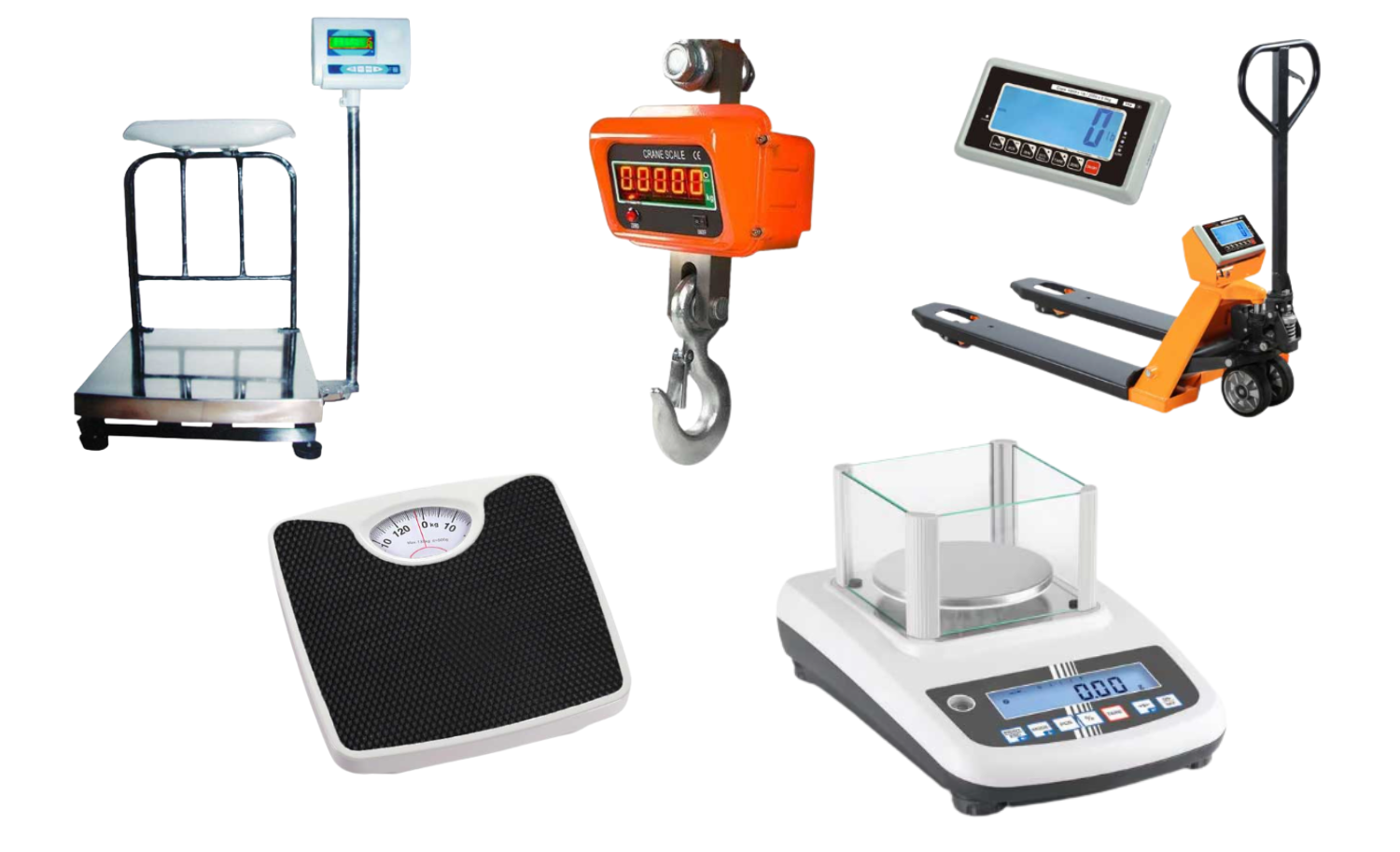
6 Main Types of Electronic Weighing Scales Used Across Indian Industries
Not every scale works for every job. Here are the six main categories, with real-world examples from Indian industry:
1. Platform Scales
Heavy-duty floor scales built for weighing large, bulky loads — sacks of grain, boxes of auto components, or bundles of steel. Textile mills in Surat and rice mills in Punjab use platform scales daily to verify incoming raw materials and outgoing dispatches. Capacity typically runs from 100 kg to 3,000 kg.
→ Explore Apple Weigh’s Platform Scales.
2. Crane Scales
Crane scales (also called hanging scales) measure the weight of suspended loads without needing a platform. They hook directly onto a hoist or overhead crane, giving real-time weight data during lifting operations. Steel plants in Raipur and port terminals in Mumbai rely on these for safe load management and billing accuracy.
→ View Apple Weigh’s Crane Scales for industrial use.
3. Bench Scales
Compact tabletop scales used on workbenches in pharma packaging lines, courier sorting centres, and food processing units. With capacities from 1 kg to 30 kg and readabilities down to 0.1 grams, they are the workhorse of precision-sensitive operations. Pharmaceutical companies in Hyderabad and Ahmedabad depend on bench scales for accurate dosing during tablet packaging.
4. Jewellery Balances & Precision Scales
Gold traders, hallmarking centres, and gemstone dealers need accuracy that standard scales cannot provide. Jewellery balances measure to 0.001 gram (1 milligram) and are calibrated to OIML Class II or III standards. These are mandatory in BIS-registered hallmarking centres across India.
→ Discover Apple Weigh’s Jewellery Balances & Scales.
5. Truck Weighbridges
Large-capacity floor scales — typically 40 to 120 tonnes — installed at the entry and exit of mining sites, cement plants, and logistics hubs to weigh fully loaded trucks. They support compliance with MoRTH overloading norms and enable accurate inventory management and GST/e-way bill generation.
6. Counting Scales
Counting scales let manufacturers count large quantities of identical small parts — screws, bolts, tablets, or electronic components — by weight in seconds. An auto-parts assembler in Pune, for example, can count 10,000 fasteners instantly by entering the known piece weight. This eliminates manual counting errors entirely.
Key Benefits of Using an Electronic Weighing Scale in Your Business
Switching to a quality digital weighing machine delivers concrete, measurable advantages:
- Accuracy within ±0.1% or better — compared to 1–5% drift in mechanical scales, this means fewer billing disputes and less product giveaway on every shift.
- Legal compliance — a verified electronic scale protects your business from Legal Metrology inspections and fines up to ₹25,000 per violation under the Legal Metrology Act, 2009.
- Real-time data connectivity — RS-232, USB, or Bluetooth output feeds weight data directly into your ERP, billing, or WMS software, eliminating manual entry errors and speeding up documentation.
- Faster throughput — auto-zero, tare function, and instant display cut per-transaction weighing time by 30–50% versus mechanical alternatives. On a busy packaging line, that is a significant capacity gain per shift.
- Lower long-term maintenance cost — no springs to fatigue, no knife-edges to wear. A well-maintained electronic weighing machine lasts 10–15 years with only annual calibration needed.
- Tamper-evident audit trail — digital indicators log transactions with timestamps and operator IDs, valuable for pharma GMP compliance, FSSAI food safety audits, and export documentation.
How to Choose the Right Electronic Weighing Scale — 7 Factors to Check
These seven questions will help you narrow down the right model for your specific operation:
- What is the maximum weight you need to measure? Always choose a capacity 20–30% above your heaviest expected load. Repeatedly overloading a scale — even by 10% — permanently deforms the load cell.
- What readability (precision) does your process require? A grain trader needs ±10 g. A pharma packager needs ±0.1 g. Match the scale’s readability to your actual process tolerance — over-specifying wastes money; under-specifying causes quality failures.
- Is the scale BIS-certified and legally verified? For any commercial buying, selling, or billing by weight, the scale must carry a current verification stamp from the local Weights & Measures Inspector. Ask your supplier for documentation.
- What is the use environment? Dusty godown or outdoor yard — specify IP65 or IP67 rating. Wet or chemical washdown area — specify stainless steel construction and sealed load cells. Standard indoor scales fail in these conditions within months.
- Does it need software or printer connectivity? If you generate weight tickets, dispatch notes, or GST invoices from the scale, confirm the indicator supports RS-232 or USB output and is compatible with your billing or ERP software.
- Who provides calibration and after-sales service? Annual statutory calibration is mandatory. Ask your weighing machine supplier for a Service AMC (Annual Maintenance Contract) and confirm they have a trained engineer in or near your city.
- Does the supplier stock genuine spare parts locally? Load cells and indicators can fail. A supplier who keeps spares nearby can restore you to operation within 24 hours. An importer without local stock could leave you offline for weeks.
4 Common Mistakes to Avoid When Buying a Digital Weighing Machine
|
Mistake 1: Buying on price alone. A cheap electronic weighing machine from an unknown brand might save ₹5,000 upfront but fail calibration within 6 months, leaving you with a non-compliant instrument and no service backup. Mistake 2: Ignoring the environment rating. Placing an indoor-rated scale in a dusty store, chemical environment, or outdoor yard voids the warranty and destroys the load cell within months. Always check the IP rating. Mistake 3: Skipping annual verification. Every electronic weighing scale drifts slightly over time due to temperature changes, vibration, and general wear. Skipping the annual Weights & Measures check is a legal violation and an accuracy risk. Mistake 4: Choosing the wrong capacity. Sizing a scale too close to your typical load and then regularly overloading it is the single most common cause of premature load cell failure in Indian factories. Always size up. |
Why Choose the Apple Weighing Infra System for Your Electronic Weighing Scale Needs?
Apple Weighing Infra System is a trusted manufacturer and supplier of electronic weighing scales across India, serving industries from pharmaceuticals and logistics to jewellery and heavy engineering. Every electronic weighing scale we supply is BIS-certified, verified under the Legal Metrology Act, and backed by a trained service team with genuine spare parts availability. Our product range covers platform scales, crane scales, jewellery balances, truck weighbridges, and customised industrial weighing solutions. We offer Service AMCs, on-site calibration, and dedicated technical support — so your scale stays accurate, compliant, and running.
→ Browse our full product range: Apple Weighing Infra Products
Frequently Asked Questions About Electronic Weighing Scales
Q1. What is the difference between an electronic weighing scale and a digital weighing machine?
Both terms refer to the same category of instrument. An electronic weighing scale uses load cell sensors and a digital indicator to display weight. The term ‘digital weighing machine’ is more common in retail and household contexts, while ‘electronic weighing scale’ is used in industrial and commercial settings. For commercial use in India, both must be verified under the Legal Metrology Act, 2009.
Q2. How accurate is a typical electronic weighing scale?
A quality electronic weighing scale maintains accuracy within ±0.01% to ±0.1% of the applied load, depending on class and capacity. This is far more consistent than mechanical spring balances, which typically drift by 1–5% with regular use. Accuracy degrades only if the scale is overloaded, used in extreme environments, or not calibrated annually.
Q3. Which types of weighing scales are best for industrial use in India?
For heavy-duty industrial applications — warehouses, factories, and logistics — platform scales (100 kg to 3,000 kg) and truck weighbridges (40–120 tonnes) are the standard choice. For manufacturing lines, bench scales and counting scales deliver the precision needed. An experienced weighing machine supplier for industrial use will help you match the right model to your specific load range, environment, and data requirements.
Q4. Is it legally mandatory to verify a weighing scale in India?
Yes. Under the Legal Metrology Act, 2009, every weighing instrument used for commercial transactions must be verified and stamped by an authorised Inspector of Weights & Measures. Verification must be renewed annually. Using an unverified or inaccurate scale in trade can attract fines up to ₹25,000 per instrument and potential seizure of goods.
Q5. How often should an electronic weighing machine be calibrated?
Statutory re-verification is required annually by the local Weights & Measures department. Beyond that, internal calibration checks using certified test weights should be performed monthly — or after any scale relocation, servicing, or exposure to unusual shock or vibration. This is especially important for electronic weighing machine India deployments in high-throughput environments like food processing or pharmaceuticals.
Ready to Choose the Right Electronic Weighing Scale for Your Business?
Getting your weighing right comes down to three things: the right capacity for your heaviest load, the right accuracy for your process, and a supplier who supports you long after the sale. Miss any one of these, and you will pay for it in compliance issues, product losses, or unexpected downtime.
Apple’s Weighing Infra System makes all three straightforward. From precision jewellery balances to heavy-duty crane scales and truck weighbridges, we have the right instrument for every Indian industrial application — and the local service team to keep it running accurately for year.