Did you know that under the Motor Vehicles (Amendment) Act, 2019, a single overloaded truck can cost you a fine of ₹20,000 plus ₹2,000 for every extra tonne it carries — and the vehicle cannot move until the excess load is physically removed? For a fleet operator running dozens of trucks daily, that kind of surprise can derail an entire supply chain.
This is exactly where truck weighing scales — specifically, weighbridges — become not just useful, but essential. Whether you run a logistics firm, a mining unit, a quarry, or a highway freight operation, understanding what a weighbridge is, how it works, and which type fits your needs can save you serious money, legal headaches, and operational delays.
In this guide, we break it all down in plain language.
What Are Truck Weighing Scales and How Do They Work?
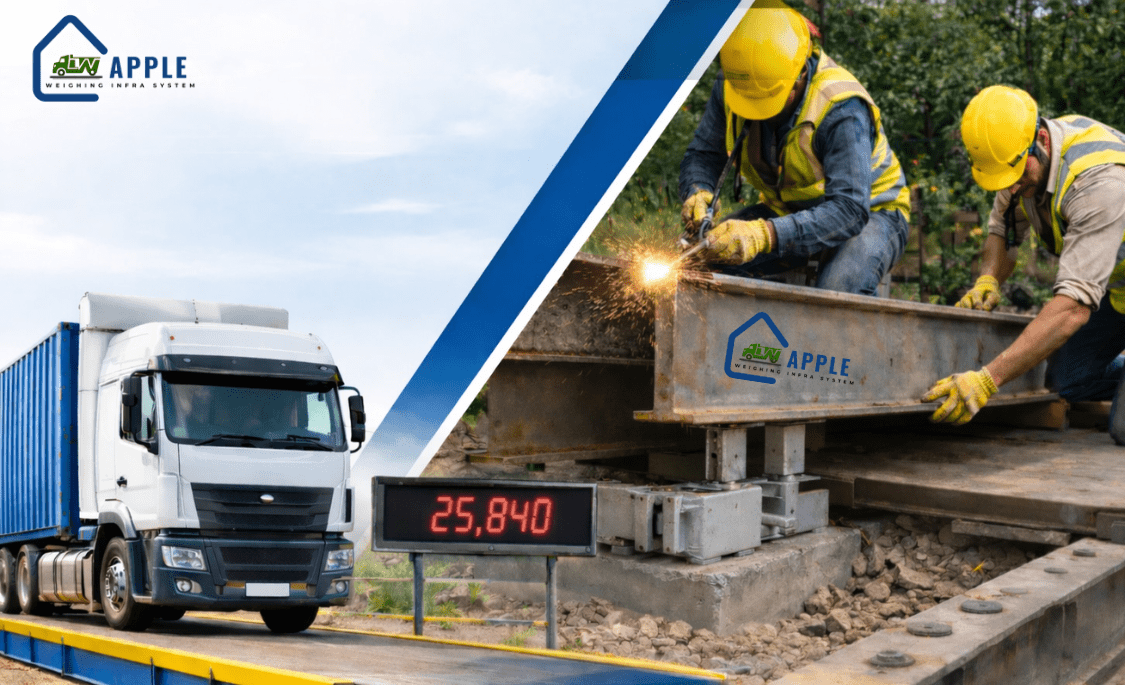
A truck weighbridge — also called a lorry weighbridge or heavy vehicle weighing scale — is a large platform scale designed to measure the total weight of a loaded truck, trailer, or any heavy commercial vehicle. The vehicle simply drives onto a flat steel or concrete platform, and the system records its weight within seconds.
At the heart of every weighbridge are load cells — electronic sensors installed beneath the platform. When a vehicle drives onto the platform, the load cells compress slightly and convert that physical force into an electrical signal. This signal is processed by a digital indicator to display the precise weight, usually in tonnes.
Most modern weighbridges in India also connect to a computer system that prints weight tickets, stores records, and even integrates with GST and e-way bill software — making compliance faster and paperwork nearly automatic.
In simple terms: a truck drives on, a number appears, and that number keeps your business on the right side of the law.
Types of Weighbridges Used in India — Which One Is Right for You?
Not every weighbridge is the same. The right type depends on your site, budget, and how much traffic you handle. Here are the five main types:
1. Pit Type Weighbridge
The platform is installed flush with the ground inside a constructed pit. Vehicles drive straight on without any ramps. This makes entry and exit smooth and fast — ideal for high-traffic sites like cement plants in Rajasthan or steel yards in Jharkhand. The downside: civil construction (the pit) adds to the upfront cost.
2. Pitless (Above-Ground) Weighbridge
The scale platform sits above ground with ramps on both ends. No excavation is needed, so installation is faster and cheaper. It is the most popular choice for coal depots, agriculture warehouses, and small logistics hubs across India. Easy to relocate if your facility moves.
3. RCC (Reinforced Concrete) Weighbridge
Built with a reinforced concrete platform on top of load cells. Extremely durable and low-maintenance — a common choice for mining operations in Odisha and Chhattisgarh, where heavy, abrasive loads are the daily norm. Concrete absorbs wear far better than mild steel in harsh outdoor environments.
4. Portable / Mobile Weighbridge
Modular, moveable platforms that can be set up and relocated without permanent civil work. Useful for construction sites, temporary checkpoints, and businesses that need weighing at multiple locations. Capacity typically ranges from 30 to 60 tonnes.
5. Weigh-In-Motion (WIM) System
These are high-tech systems embedded in the road surface. They capture the axle weight and total vehicle weight as a truck drives over — without stopping. WIM technology is increasingly used at toll plazas and state highway checkpoints across India, and from December 2024, the government began piloting On-Board Weighing (OBW) sensors in heavy commercial vehicles.
What Is an Electronic Weighing Scale? Types, Uses & How to Choose the Right One
6 Real Benefits of Installing Truck Weighing Scales for Your Business
Installing a weighbridge is not just a compliance checkbox — it actively improves how your operation runs. Here is what you get:
- Zero overloading fines: With your own truck weighing scale, every vehicle is checked before it leaves. You never send an overloaded truck onto the road, which means zero exposure to the ₹20,000+ penalties under the Motor Vehicles Act.
- Accurate inventory and billing: Every tonne in and out is recorded precisely. This eliminates disputes with suppliers and customers over short-delivery claims — a common problem in coal, sand, and grain trading.
- Faster GST and e-way bill compliance: Modern weighbridges integrate with billing software. Weight data flows directly into invoices and e-way bills, cutting the time your dispatch team spends on paperwork.
- Longer vehicle life and lower maintenance: Overloaded trucks suffer faster tyre wear, brake stress, and chassis fatigue. Weighing every load and staying within limits can extend your truck’s service life by years.
- Protection against fraud: Without a weighbridge, it is easy for drivers or loaders to manipulate load quantities. A weighbridge creates a verifiable, time-stamped record for every trip.
- Stronger client trust: Delivering exactly what was agreed — verified by a calibrated weighbridge — builds long-term client confidence. It is a simple competitive advantage.
How to Choose the Right Truck Weighbridge — 7 Things to Check Before Buying
Buying a weighbridge is a significant capital investment. Take time to evaluate these seven factors before you finalise your purchase:
- Capacity (in tonnes): Match the weighbridge capacity to your heaviest loaded vehicle — not the average. If you occasionally handle tri-axle trucks at 40–50 tonnes, a 60-tonne capacity bridge gives you safe headroom. Never buy exactly at your peak load.
- Platform size (length x width): Standard lorry weighbridge dimensions in India range from 9m x 3m to 18m x 3.4m. A bridge that is too short means your truck wheels hang over the edge, giving inaccurate readings. Know your longest vehicle before you specify size.
- Pit vs pitless construction: Evaluate your site conditions. If ground is wet, rocky, or frequently flooded, pitless is safer. If you have high vehicle throughput and want fast, ramp-free access, a pit type is worth the civil investment.
- Load cell quality and IP rating: Insist on hermetically sealed load cells with IP68 or IP69K rating. This protects the sensors from water, dust, and chemicals — critical for outdoor industrial sites in India where monsoon flooding is a real concern.
- Software and connectivity: Check that the indicator software integrates with your ERP, billing, or GST filing system. Ask if the system supports automatic weight tickets, CCTV integration, and remote access.
- Legal Metrology certification: Under the Legal Metrology Act, 2009, commercial weighing instruments must be verified and stamped by a government-approved authority. Confirm your supplier provides NABL-traceable calibration and supports re-verification.
- After-sales service network: A weighbridge breakdown halts your entire operation. Ask specifically about the supplier’s service response time, availability of spare load cells, and whether they offer Annual Maintenance Contracts (AMC).
Common Weighbridge Buying Mistakes You Must Avoid
Even experienced buyers get caught out by these mistakes:
- Choosing on price alone: A cheap electronic weighbridge with low-quality load cells will drift out of calibration quickly, costing you far more in disputes and re-calibration visits than you saved upfront. Total cost of ownership matters more than the sticker price.
- Ignoring site preparation: A weighbridge installed on soft or improperly compacted ground will give inconsistent readings within months. Always get a civil site assessment done before installation.
- Buying from a reseller without manufacturer support: Some suppliers simply resell imported components without any local service capability. If a load cell fails six months later, you could wait weeks for a part. Always confirm your supplier is a manufacturer or authorised distributor with a local service team.
- Skipping the Legal Metrology stamp: Using an unstamped weighbridge for commercial transactions is a legal offence under the Legal Metrology Act. Do not start commercial operations until your weighbridge has been inspected and stamped by the Weights and Measures department.
Why Choose Apple Weigh Infra System for Your Truck Weighing Scales?
Apple Weigh Infra System is a trusted manufacturer and supplier of truck weighing scales and industrial weighing equipment across India. Our weighbridges are built with high-precision, IP68-rated load cells, robust steel platforms, and software that integrates seamlessly with GST and e-way bill systems. From pitless to RCC designs, we offer solutions engineered for India’s toughest operating environments — quarries, ports, cement plants, and logistics hubs alike. Backed by a national service network, fast-response AMC plans, and full Legal Metrology compliance support, we make sure your weighbridge earns its keep from day one.
Frequently Asked Questions About Truck Weighbridges in India
What is the price of a truck weighbridge in India?
A basic pitless truck weighbridge in India typically starts from ₹3.5 to ₹5 lakhs, depending on capacity, platform size, and software features. RCC and pit-type models with automation can range from ₹6 to ₹15 lakhs. Civil work costs are separate. Always request a site-specific quote from an electronic weighbridge manufacturer in India for accurate pricing.
Is it mandatory to have a weighbridge for logistics companies in India?
While not mandatory for every logistics operator, using certified truck weighing scales is required for commercial transactions under the Legal Metrology Act, 2009. Additionally, transporting goods in overloaded vehicles violates the Motor Vehicles Act, making weighing a practical legal necessity for any serious freight operation.
How accurate is a truck weighbridge?
A properly calibrated electronic weighbridge for trucks is accurate to within ±0.1% of the measured load. Accuracy depends on load cell quality, installation surface stability, and regular recalibration. NABL-calibrated systems verified by the Weights and Measures department meet India’s commercial accuracy standards.
What is the difference between a truck weighbridge and an axle weighbridge?
A truck weighbridge measures the total gross vehicle weight in a single pass. An axle weighbridge (or axle weigh pad) measures the weight on individual axles separately. Axle weighing is important for MoRTH compliance since Indian law sets specific limits per axle type, not just total vehicle weight.
Do I need a government licence to operate a weighbridge in India?
Yes. Under the Legal Metrology Act, 2009, any weighbridge used for commercial transactions must be verified and stamped by the state Weights and Measures department. The weighbridge also needs periodic re-verification (typically annually). Operating an unstamped weighbridge for trade is a punishable offence.
Ready to Install the Right Truck Weighing Scales for Your Business?
A weighbridge is one of those investments that pays for itself faster than most people expect — through fines avoided, disputes resolved, and operations streamlined. Whether you are setting up a new logistics yard, a mining site, or upgrading an existing facility, getting the right truck weighing scales is a decision worth making carefully.
Apple Weigh Infra System is here to help you get it right. Explore our full range of weighing solutions or reach out to our team for a no-obligation site assessment and quote.
Visit: appleweigh.com/apple-weighing-infra-products | Call us today | Get a free quote